The Foundation has done incredible work over the past year and below are some of the most notable accomplishments:
In 2024, we distributed five KdVS Foundation Investigator grants, all funded by the Kool Kampaign to the following recipients:
- Dr. Yann Herault, at the Institut de génétique et de biologie moléculaire et cellulaire in France, will develop a new mouse model that expands upon our previous mouse since model to allow examination of the age window for optimal therapeutic intervention in KdVS patients.
- Dr. Helen Willsey of UCSF in the United States, will establish the role of Kansl1 in cilia form and/or function; this will be critical for all aspects of KdVS research.
- Dr. Jordan Wright, Murdoch Children’s Research Institute in Australia, will be investigating whether select small molecule compounds can correct molecular deficits in KdVS cell models.
- Dr. Victor Faundez of Emory University in the US will establish a new mouse colony and begin studying their behavior to identify characteristics that can be corrected with experimental therapies.
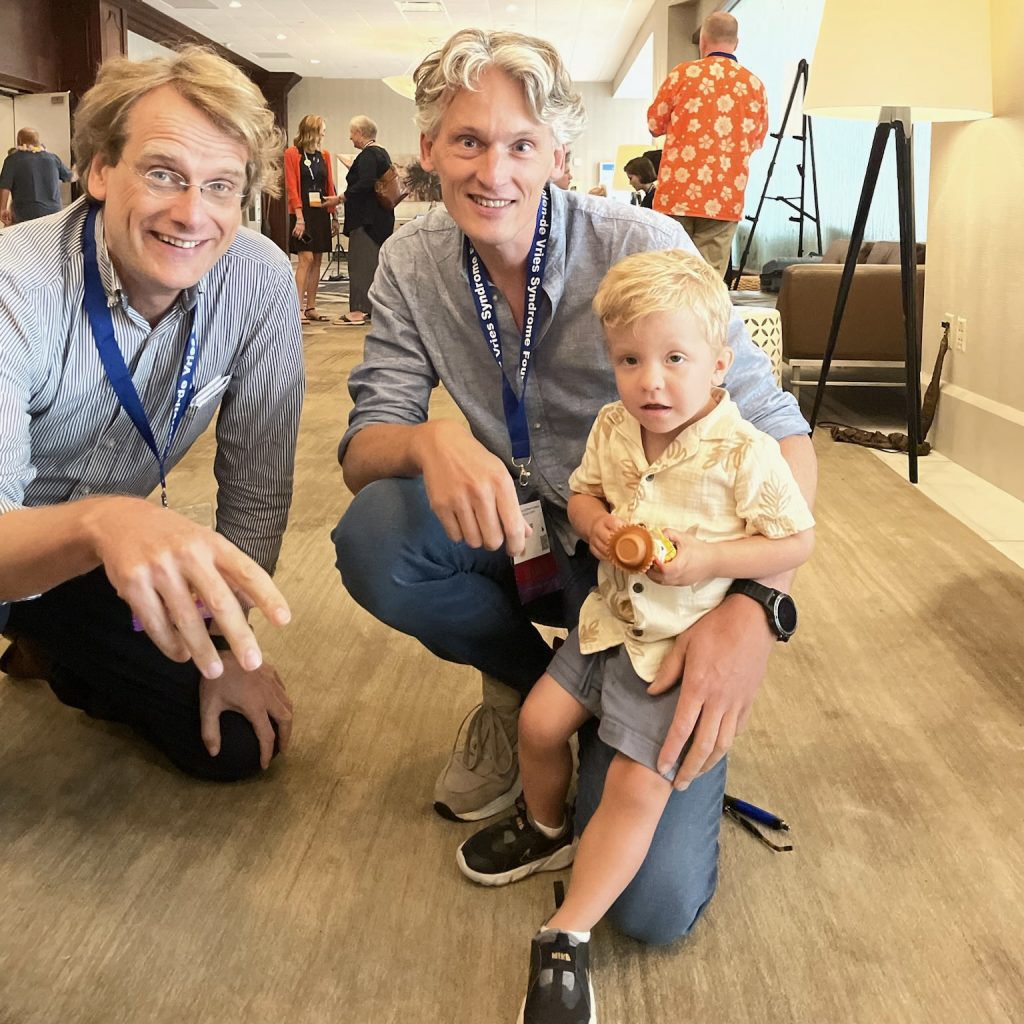
- Drs. Koolen and de Vries at Radboud UMC in the Netherlands will continue their Natural History Study. Their research staff will conduct a series of clinical assessments and biological sample collections from KdVS patients to establish a profile of the natural progression of KdVS with age.
In 2024, the Foundation funded Dr. Cristina Pardo from Erasmus University to develop fluorescent reporter lines for KdVS as a means to easily and quickly quantify changes in Kansl1 expression level in patient-derived stem cells and neuronal lines.
In 2024, the Foundation submitted a proposal to the Centers for Disease Control (CDC) to receive an ICD-10 code. An ICD-10 code will allow physicians to document KdVS in the patient’s medical record, have KdVS recognized by insurance providers, and allow researchers to track the number of current and new cases.
In 2024, The Foundation submitted and got its first paper accepted to the Journal of Frontiers of Neuroscience which describes the journey from diagnosis to treatments in KdVS. In addition to this manuscript, the Foundation has submitted several abstracts to Global Genes and the American Epilepsy Society to further promote awareness around KdVS.
In 2023, we, along with CURE Epilepsy, awarded a 2-year grant to Dr. Hans van Bokhoven at Radboud University Medical Center. The KdVS Foundation was chosen to partner with CURE Epilepsy to each provide a $50,000 grant. This $100,000 grant is being used to examine the feasibility of suppressing a naturally occurring non-coding RNA as a means to increase KANSL1 protein expression. Similar strategies are currently being used in clinical trials for several neurological diseases.
In 2023, we also awarded a Young Investigator Grant to Dr. Esmat Fathi, a post-doctoral fellow, at St. Jude Children’s Research Hospital. Dr. Fathi received a grant for $40,000 to study two promising molecular strategies to rescue haploinsufficiency in KdVS. It is well-known that KdVS is caused by having only 50% of the KANSL1 protein and Dr. Fathi’s work will attempt to use CRISPR- technology as well as other technologies to increase KANSL1 expression in patient cells.
In 2023, Our KdVS Foundation Biorepository sponsored COMBINEDBrain and Simons Searchlight teams to collect over 60 samples from KdVS patients and family members at our Patient Advocacy Summit and at patient homes. Our biorepository collects, processes and stores a variety of biofluids and cell lines to provide to researchers studying KdVS. These resources provide the necessary tools to study the cause of disease as well as treatment options in patient-derived samples and models. We have already provided portions of these resources to 4 different academic researchers and 8 different pharmaceutical companies. As our research community grows, we recognize the need to hold quarterly medical advisory board meetings and bi-annual Summits to provide research updates and establish new collaborations and attract new investigators to the field of KdVS. To help support these efforts, the Foundation consistently seeks funding through various entities including, the US National Institutes of Health, Global Genes, Simons Searchlight, the Chan Zuckerberg Institute, and the EveryLife Foundation.